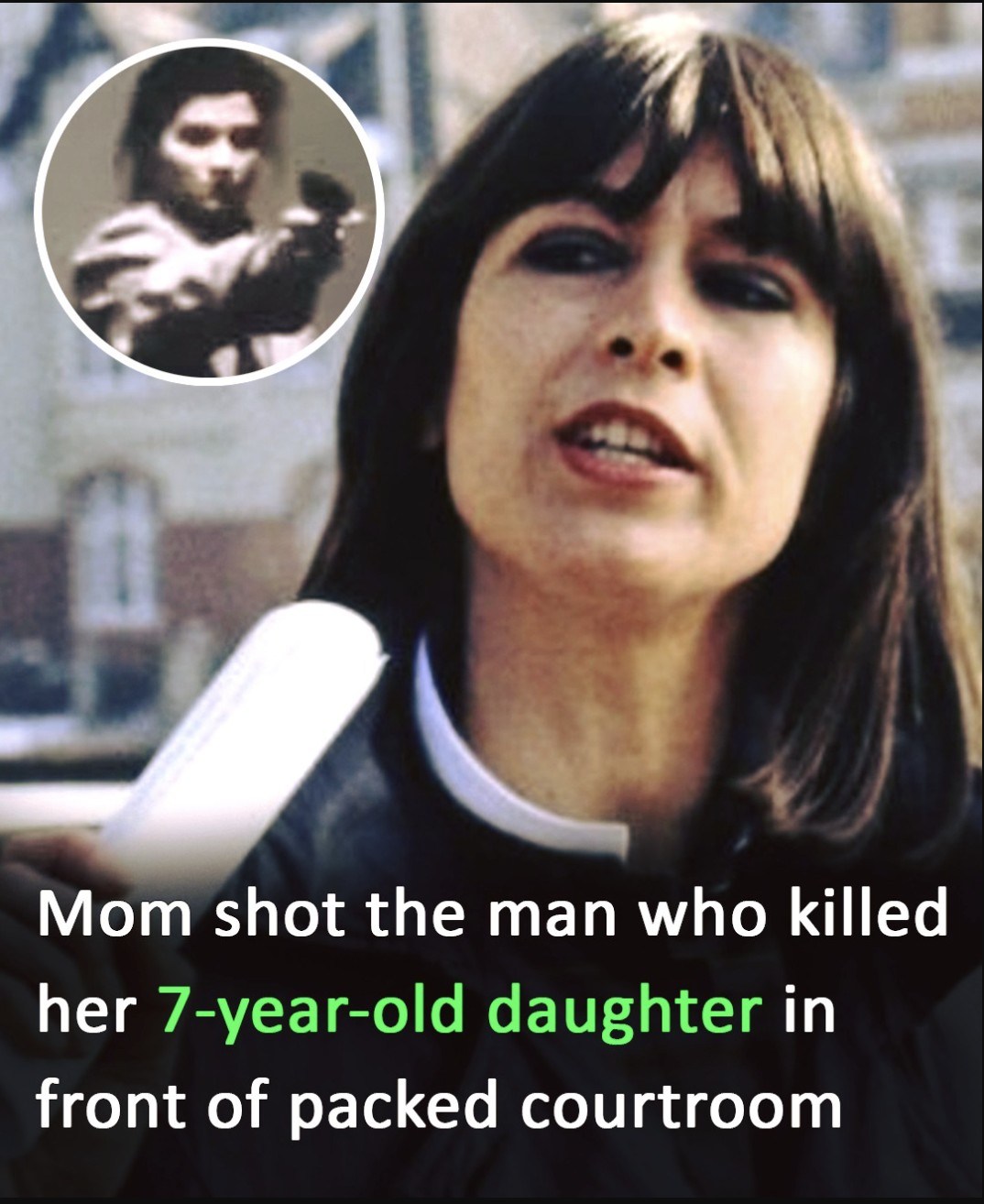
On March 6, 1981, Marianne Bachmeier walked into a courtroom in Lübeck, Germany, with determination in every step.
Then, without warning, she pulled a loaded pistol from her purse and opened fire on 35-year-old sex offender Klaus Grabowski.
This man had been charged with the kidnapping, abuse, and murder of Marianne’s 7-year-old daughter, Anna Bachmeier.
Moments later, Grabowski breathed his last and collapsed on the courtroom floor – struck by seven of Marianne’s bullets. The grieving mother was promptly arrested but displayed no signs of regret. Four decades later, the “Revenge mom” remains etched in the public consciousness – and her sentence still splits a nation…
The loss of a child is the most profound tragedy, often described as the worst ordeal a parent can face.
On May 5, 1980, Marianne Bachmeier’s world was irrevocably altered. During the 1980s, Marianne was a struggling single mother who operated a pub in Lübeck, northern Germany.

Marianne’s youth was filled with hardship and numerous traumas. Her father was part of the Waffen-SS, one of the most notorious groups in Nazi Germany.
As she grew up, she experienced multiple instances of rape by various men. At the young age of 16, Marianne became pregnant. Unable to care for the baby by herself as a teenager, she chose to put the child up for adoption. When she turned 18, Marianne found herself pregnant again – and once more, she entrusted her baby to an adoption agency.
In 1973, Marianne welcomed her third child, a daughter named Anna. Although still a single mother, she took on the responsibility of raising Anna by herself.
Reports indicate that Anna was a “joyful, open-minded child,” but sadly, she and her family were soon to face a tragic event.
In May 1980, Anna and Marianne had a disagreement. The young girl chose to skip school and headed to a friend’s house instead. However, on her way, Anna was abducted by 35-year-old Klaus Grabowski, a local butcher.
Grabowski held Anna captive in his apartment for several hours, during which he abused her before ultimately strangling her to death. After killing Anna, he placed her body in a box and concealed it in a secret spot along the bank of a canal.
Later, Grabowski returned to the site to bury his victim’s body, but he was arrested that same evening at his favorite pub in Lübeck after his fiancée reported him to the authorities.
At that time, Grabowski was already a convicted sex offender who had previously served time for sexually assaulting two girls.
While in prison in 1976, he chose to undergo voluntary castration. Two years later, he started hormone therapy to reverse the effects of the chemical castration, hoping to have a romantic relationship with his fiancée.
Grabowski quickly admitted to murdering Anna but denied any sexual abuse of the girl. During his trial, he went even further, asserting that Anna had attempted to seduce and extort him.
In reality, Grabowski shifted the blame onto his murder victim for his disgraceful actions. He claimed that he only killed the young girl because she was trying to blackmail him. According to Grabowski, Anna threatened him, demanding money or she would inform her mother that he had touched her inappropriately.
The court did not find Grabowski’s explanation credible.
However, his bizarre and unsettling narrative drove Anna’s mother, Marianne, to the brink of madness, leaving her feeling powerless, furious, and enraged. On March 6, 1981, on the third day of the trial, Marianne resolved to take action herself.
Somehow, she managed to sneak a gun into the courtroom, evading security checks and guards. Shortly after entering the room, she drew the loaded gun from her handbag, aimed it at her daughter’s murderer, and fired all the rounds. Seven out of eight bullets struck their target, and Grabowski collapsed immediately. He died on the spot.
Right after the shooting, Anna’s mother dropped her weapon, a Beretta M1934. Her voice then echoed in the room:
“He killed my daughter… I wanted to shoot him in the face, but I shot him in the back … I hope he’s dead.”
According to two police officers present, Marianne also referred to Grabowski as a “pig” after she opened fire.
She was taken into custody by the police in the courtroom and initially charged with murder. During her trial in 1982, Marianne claimed that she shot Grabowski while in a dream-like state after envisioning her daughter in the courtroom.
However, experts who provided testimony during the trial stated that Marianne’s actions necessitated specific training with the firearm, suggesting that she had meticulously planned and organized everything prior to the shooting.

The mother underwent an examination by doctors who requested a handwriting sample from her. In reply, Marianne wrote: “I did it for you, Anna.” The sample was adorned with seven hearts, which many saw as a tribute to each year of Anna’s life.
If found guilty, Marianne would face a lifetime behind bars.
The mother’s act of vigilantism attracted massive media coverage, not just in Germany but globally. Marianne was labeled “Revenge mom,” and many believed she should be acquitted during the trial.
The grieving mother, who sought vengeance for the death of her cherished daughter, received widespread admiration and a great deal of support and understanding, despite the vigilante actions she took.

Initially, the media depicted Marianne as a saint. However, journalists soon began to investigate her background. They discovered that Marianne had given her first two children up for adoption. Additionally, her frequent visits to the bar where she worked were among the details that started to tarnish her image as a devoted and selfless mother.
In 1983, Marianne was found guilty of premeditated manslaughter and illegal possession of a firearm. She received a six-year prison sentence but was released after serving three years.
Her sentence sparked division among the public, as indicated by a survey conducted by the Allensbach Institute. Approximately 28 percent considered her six-year sentence to be appropriate, while another 27 percent thought it was too harsh, and 25 percent felt it was too lenient.
After completing her prison term, Marianne moved to Nigeria and married a German teacher. In 1990, she divorced and relocated to Sicily, Italy.

Sadly, Marianne was ultimately diagnosed with pancreatic cancer and returned to her homeland and hometown, Lübeck.
Her act of vengeance continued to resonate in the memories of many Germans; newspapers still reported on the event well into the 1990s.
In 1994, 13 years after her act, she participated in a rare interview on German radio.
“I believe there is a significant difference between killing a little girl out of fear of spending my life in prison. And then there’s the ‘how’—for instance, standing behind the girl and strangling her, which is taken directly from his statement: ‘I heard something come out of her nose, I was fixated, then I could no longer bear the sight of her body,’” she remarked.

Unfortunately, Marianne was eventually diagnosed with pancreatic cancer and made her way back to her homeland and hometown, Lübeck.
Her quest for vengeance continued to linger in the minds of many Germans; newspapers kept covering the story well into the 1990s.
In 1994, thirteen years after her act, she took part in a rare interview on German radio.
“I think there’s a major distinction between killing a young girl out of fear of spending my life behind bars. And then there’s the ‘how’—for example, standing behind the girl and choking her, which is directly taken from his statement: ‘I heard something come out of her nose, I was fixated, then I could no longer bear the sight of her body,’” she stated.