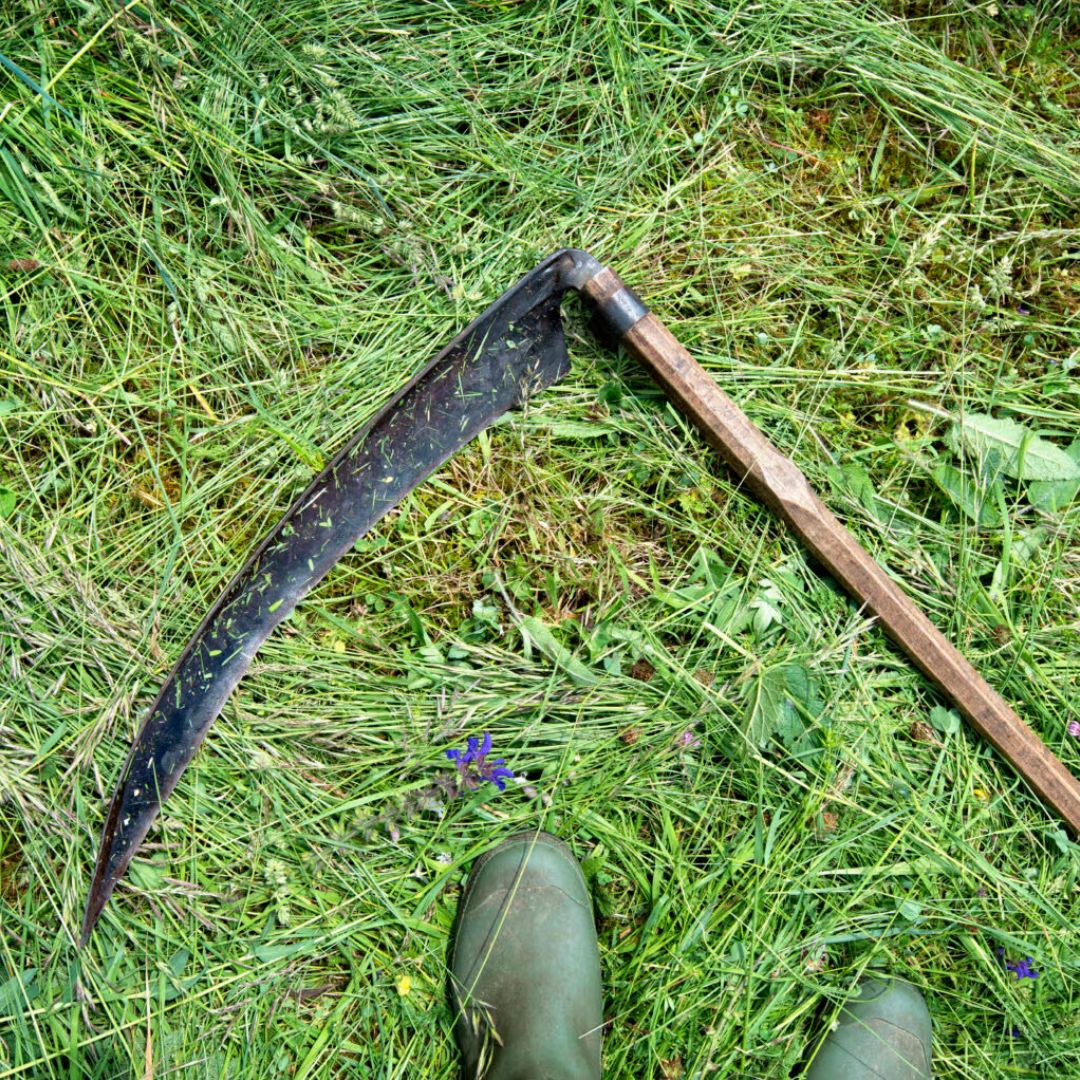
What the Object Is
The tool in the photo is a scythe—a traditional, human-powered cutting tool designed to mow grass, harvest hay, and cut grain or weeds. It is recognized by its long wooden handle and long, curved steel blade mounted at an angle.
Name and Common Terms
- Primary name: Scythe
- Related terms (often confused):
- Sickle (shorter, hand-held curved blade used close to the body)
- Grass hook / reaping hook (varies by region; generally smaller than a scythe)
- Key distinction: A scythe is built for sweeping, wide strokes across a field, typically for larger areas than a sickle.
Main Parts (How to Identify It)
- Blade (steel): Long and curved, made for slicing through stems cleanly.
- Handle (wooden shaft): Long lever that increases reach and efficiency.
- Mount/neck (where blade meets handle): The joint that sets the blade angle for a smooth cutting arc.
What It Was Used For
A scythe’s core job is simple: cutting vegetation efficiently using a swinging motion. Historically, it was essential for farm life because it could handle large areas without animals or engines. Typical uses include:
- Mowing hay for livestock feed
- Cutting tall grass in fields and meadows
- Harvesting certain crops (depending on blade type and region)
- Clearing weeds and brush around farmland and paths
When It First Appeared (Time of Origin)
Scythes (and scythe-like mowing tools) trace back to early agricultural societies. While designs evolved by region, the scythe became widely associated with pre-industrial farming, especially across Europe and parts of Asia, and remained a primary mowing tool up through the 18th–19th centuries, before mechanical mowers became common.
Who Created It (Inventor)
There is no single known inventor of the scythe. Like many foundational farm tools, it emerged through gradual improvements by farmers and blacksmiths over centuries. What changed over time was:
- Blade metallurgy (stronger, thinner steel for cleaner cutting)
- Blade shape and length (optimized for grass vs. grain)
- Mounting methods (more stable joints and better cutting angles)
Why It Matters (Practical Advantages)
Even today, scythes are still used in some places because they can be:
- Quiet and fuel-free
- Precise around trees, stones, and uneven ground
- Low-impact compared with some powered cutting methods
- Repairable (blade maintenance and sharpening are possible without complex parts)
Quick Safety Notes (Important if Handling One)
- Treat the blade as razor-sharp, even if it looks aged.
- Carry it with the blade facing away and the cutting edge protected when possible.
- Use controlled swings and ensure the area is clear of people, animals, and obstacles.
In One Sentence
The object shown is a scythe, an ancient, blacksmith-refined farming tool used for mowing grass and harvesting field crops long before modern machines.
